
Home · Commercial · Dental Offices
Florida · Dental practicesDental Office Pest Control
A dental practice is the smallest footprint in healthcare and the one with the closest patient proximity - somebody is lying on their back, mouth open, looking directly at your ceiling tile for forty minutes. It is also the one building type with two pest sources nothing else has. Venus services dental offices on evening windows, with targeted low-odour materials and the two dental-specific lines checked every visit.
If you keep seeing gnats, it is the trap or the line.
A dental office that keeps reporting small flies almost never has a housekeeping problem. It has a plumbing problem, and it is one of two. The plaster trap holds a wet organic sludge in a canister inside a cabinet that gets opened when it is serviced and at no other time. The suction and vacuum lines hold biofilm along their whole run, and the solids collector at the end of it holds more. Both are warm, both are permanently damp, both are organic, and both will breed drain flies and small flies steadily while every visible surface in the operatory is genuinely spotless.
This is why practices get frustrated with pest contractors. A technician who sprays baseboards and leaves will kill the adults in the room and change nothing about the source, so the flies are back within the week and the practice concludes pest control does not work. What works is finding the line, treating it with a material that breaks down the biofilm rather than just wetting it, and telling your team which service interval is actually causing it.
The whole suite, in one evening.
A practice is small enough to be covered completely in a single after-hours visit, which is exactly why there is no excuse for any of it being skipped.
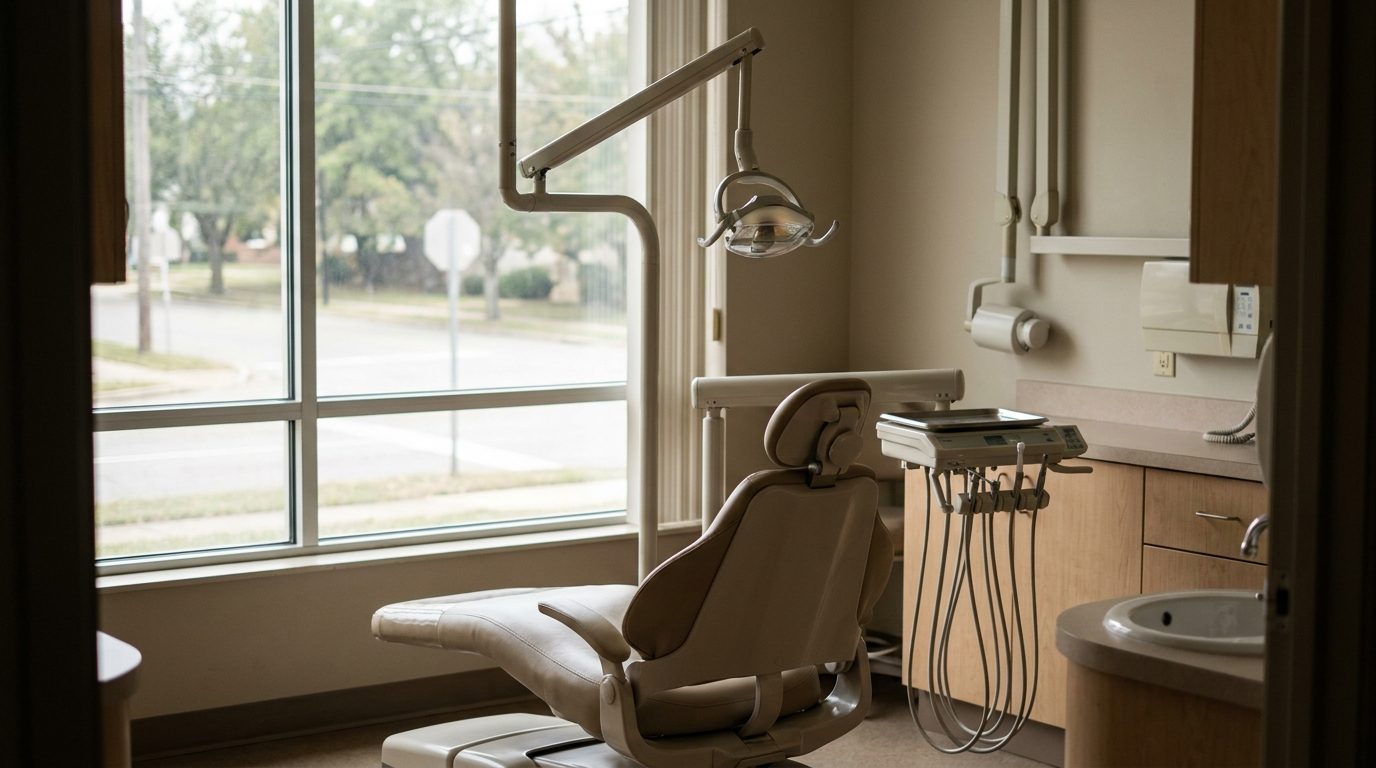
Chair base and hydraulics, delivery unit, cabinetry toe kicks, sink cabinet, the wall penetration behind the unit and the void where the lines run.
Ultrasonic, autoclave surround, the warm equipment void behind it and the cabinetry underneath. Warmth plus moisture in a small room.
Model trimmer, plaster bench, the trap itself and everything under the sink. The messiest room in a dental office by a distance.
The candy or mint bowl, the coffee station, upholstered waiting seating and the toy bin if there is a kids' corner.
Microwave surround, fridge motor housing, toe kicks and the cardboard from the supply order. The usual source for anything that is not the plumbing.
Compressor and vacuum pump room, supply boxes, the water heater closet and the exterior wall penetrations where the lines exit.
The other call we get from dental offices.
Dentistry runs on sweet liquids - fluoride varnish, prophy paste, flavoured rinse, the mint bowl at the front desk - and a practice rinses most of it down an operatory sink several times a day. That is a permanent sugar source at a permanent water source, which is precisely what a sugar-feeding ant colony is looking for. Ghost ants and white-footed ants are the two we see most in South Florida dental suites, and both of them nest in wall voids and trail along the plumbing rather than living in the room you can see.
They are also both bait problems. Spraying a trail in an operatory kills the workers you can see, leaves the colony intact, and in the case of ghost ants frequently splits it. The right answer is the correct bait matrix placed on the trail, patience, and a conversation about the rinse station.
Four things that are non-negotiable in a dental suite.
Evenings Only
After the last patient, every time. Nothing in an operatory during clinic hours and nothing that keeps a chair out of use the next morning.
No Residue Where Patients Touch
Bait and void placements. Nothing applied to chair surfaces, delivery units, counters or any instrument contact area.
Low Odour, Full Stop
A practice that smells of pest control at eight the next morning is a failure regardless of what was achieved. Material selection starts there.
Documentation On Site
Service report every visit, plus current labels and Safety Data Sheets in your file and published online for your OSHA binder and your team.
On site in 24 hours.
Commercial accounts on a signed service plan get an on-site response within 24 hours, every day of the year outside national holidays. Covered pest between visits? We come back and re-treat, free.
Straight answers.
We keep getting small flies and everything is clean. What is going on?
It is almost certainly the plaster trap or the suction line. Both hold wet organic sludge and biofilm out of sight, both are warm and permanently damp, and both will breed small flies continuously while every visible surface is spotless. Killing the adults in the room does nothing - the line has to be treated and the service interval has to change.
Do you come after hours?
Yes, evenings only as standard. Nothing happens in an operatory during clinic hours and nothing is left that keeps a chair out of use the following morning.
What do you apply in an operatory?
Targeted bait and void placements. Nothing is applied to chair surfaces, delivery units, counters or any instrument contact area, and materials are chosen for low odour because a suite that smells at eight the next morning is a failure whatever else was achieved.
We have ants at the operatory sink. Can you spray them?
We can, and it would be the wrong thing to do. Ghost ants and white-footed ants nest in wall voids and trail along the plumbing, and spraying a trail kills the visible workers while leaving the colony - with ghost ants it often splits it into several. They are controlled with the correct bait placed on the trail, plus a look at what is going down the rinse station.
Is there documentation for our OSHA binder?
Yes. A service report after every visit, plus current labels and Safety Data Sheets kept on site and published online with EPA registration numbers, managed so manufacturer revisions update automatically.
We share a building with other suites. Does that matter?
It matters a great deal. Suites share wall voids, plumbing chases and often a trash room, so an untreated neighbour will keep re-seeding you. We inspect the shared pathways and put the finding in writing for your property manager.
Do you work with multi-location dental groups?
Yes, quoted as one program with one point of contact and one invoice across all six of our live Florida markets.
We come out, walk the site, document what we find and email you our findings, pricing and options. If we are not right for you we will say so.