
Home · Commercial · Senior Living
Florida · Senior livingAssisted Living & Nursing Home Pest Control
Senior living is the hardest healthcare building to run a pest program in, and it has nothing to do with the pests. Residents live there around the clock and cannot be moved out for the day. Their rooms are full of possessions nobody is allowed to throw away. AHCA inspects. And families talk to each other, then photograph, then post. A program that works here is one built around finding things early, not one built around responding well.
Bed bugs are not an infestation problem here. They are a logistics problem.
In any other building, a bed bug finding is a treatment. In assisted living it is four separate problems at once, and the treatment is the easiest of them. The resident cannot relocate for a day. The room holds decades of possessions with real sentimental weight, and staff cannot simply bag and discard them. Half the time the resident does not report the bites at all - either they do not notice, or they do not want to be a bother, or they are worried about what happens to their room. And the first anybody hears of it is frequently a family member who has already taken photographs.
Which is why the only program worth buying in this sector is a detection program. Scheduled inspection of high-risk rooms, monitors placed under beds and behind headboards, an inspection protocol for every incoming resident's furniture, and a written response your staff already know before they need it. A community that finds a bed bug in week one has a two-hour job in one room. A community that finds it in month three has a wing, a family meeting and a survey exposure.
Move-In Inspection
Incoming furniture, mattresses and belongings inspected before they go up the corridor. The single highest-value control in the whole building and the cheapest.
Monitors In Place
Passive monitors under beds and behind headboards in high-risk rooms, checked on rotation. Detection that does not rely on anybody reporting anything.
Scheduled Room Rotation
High-risk rooms inspected on a set cycle rather than on complaint. Frequent-hospital-transfer residents and new admissions first.
Written Protocol
A response your nursing and housekeeping staff already have in hand: what to do, what not to do, who to call, and what not to move down the hallway.
Where the rest of it comes from.
Bed bugs get the attention. Roaches, ants and flies generate more of the actual complaints, and nearly all of them trace back to six places.
Food kept in the room is normal, expected and completely reasonable - and in memory care it is frequently stored in places nobody would guess. Serviced with dignity and without turning it into an incident.
Held to food-service standards. Production kitchen, servery, dish area, dry store, walk-ins and the floor drains and floor sinks that breed small flies.
Laundry rooms, linen carts, soiled holding and the trash room. Warm, damp and organic, and the route by which a problem travels between wings.
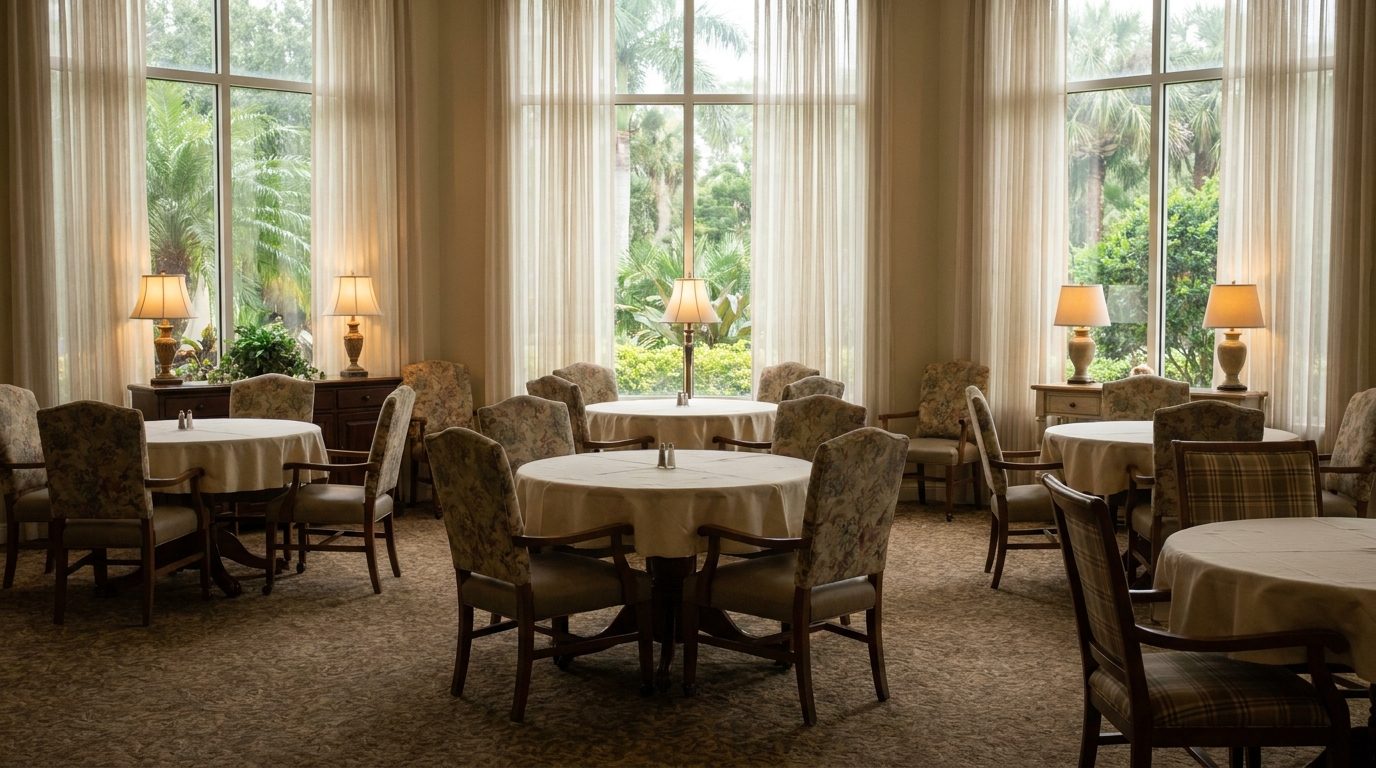
Upholstered lounge seating, the activity room, the salon, the library, the theatre and the snack station. Where sightings happen in front of visitors.
The single biggest driver of complaints in any multi-storey residential building, and senior living is no exception. Chute discharge included, not just the room door.
Fire ant control on every lawn, garden and walkway residents use - a fire ant mound beside a bench is a genuine incident risk here, not a nuisance. Plus perimeter, mosquito and mapped exterior rodent stations.
What AHCA expects to see.
We are a pest control contractor, not a survey consultant - but we know what gets asked for, because it is the same handful of documents every time.
Licensed under Chapter 429 of the Florida Statutes and inspected against Rule 59A-36 of the Florida Administrative Code, which requires the facility be maintained free of vermin and insects. A documented contractor program with service reports on file is the straightforward way to evidence that you are running one.
Licensed under Chapter 400 and inspected against Rule 59A-4, with the dietary department additionally held to food-service standards. Both the building program and the kitchen program need to be documented separately, because they get looked at separately.
- A written IPM program describing prevention and exclusion first, materials last
- A service report filed after every visit, retrievable by date
- A numbered and plotted device map covering interior and exterior
- Current labels and Safety Data Sheets on site and published online
- A written corrective action record after any finding, so the file shows you acted and when
Discreet, or it does not work.
A technician who walks a memory care corridor in a marked uniform with a sprayer creates an afternoon of anxiety, a round of phone calls to families, and a reputation problem your executive director then owns. How we are in the building matters as much as what we apply.
Resident-Safe Materials
Targeted baits and void placements. No fogging, no broadcast application in occupied rooms, and careful selection around residents with respiratory conditions.
Coordinated With Nursing
Room access arranged through your staff, never independently. Nursing and housekeeping know where we are and why before we are there.
Quiet In The Corridors
Low-visibility service in resident areas. Plant and equipment staged out of sight, and conversations about findings held in the office.
Same Technician
A fixed rotation with somebody who knows your building, your staff and which residents need a gentler approach. Familiarity is a safety feature in this sector.
On site in 24 hours.
Commercial accounts on a signed service plan get an on-site response within 24 hours, every day of the year outside national holidays. Covered pest between visits? We come back and re-treat, free.
Straight answers.
A resident has bed bugs and cannot leave the room. What happens?
That is the normal case here, and the program is built for it. The room is treated in a way that works around an occupied resident rather than requiring a vacancy, belongings are handled rather than discarded, and the rooms either side plus the one above and below are inspected the same visit. The written protocol your staff hold covers what to do before we arrive, and the most important part of it is not moving anything down the hallway.
How do we stop bed bugs arriving in the first place?
Inspect what comes through the door. Move-in inspection of incoming furniture, mattresses and belongings is the highest-value and cheapest control in the entire building, and most communities do not have it as a written step. After that it is passive monitors in high-risk rooms and a scheduled inspection rotation, so detection does not depend on anybody reporting anything.
What does AHCA ask for?
In practice: evidence that you have a pest management program and evidence that you are running it. We keep a written IPM program, a service report for every visit, a numbered device map, current labels and Safety Data Sheets, and a corrective action record after any finding. The dietary department is documented separately because it is looked at separately.
Is anything you use a risk to residents?
Materials are chosen for occupied residential care: targeted baits and void placements, no fogging, no broadcast application in occupied rooms, and particular care around residents with respiratory conditions. Every label and Safety Data Sheet is published online so your director of nursing can read them before we start rather than after.
Residents keep food in their rooms. Is that the problem?
It is a factor and it is also completely reasonable - people live there. The answer is not to police residents, it is to service the rooms properly, work with housekeeping on storage, and treat the building so a small amount of food in a room is not enough to sustain a population. In memory care we expect food in unexpected places and inspect accordingly.
Can your technician be discreet?
Yes, and we treat it as part of the job rather than a courtesy. Low-visibility service in resident areas, equipment staged out of sight, room access coordinated through your staff, and findings discussed in the office rather than the corridor.
Do you cover the kitchen and dining room?
Yes, on a full food-service program - drain lines and floor sinks included, which is where small fly problems in a dietary department actually begin. It is documented separately from the building program because a surveyor will look at it separately.
Do you handle fire ants on the grounds?
Yes, and in senior living we treat it as a priority rather than a landscaping nuisance. A mound beside a bench or on a walkway a resident uses is a genuine incident risk, so lawns, gardens, courtyards and walkways are covered.
We come out, walk the site, document what we find and email you our findings, pricing and options. If we are not right for you we will say so.