
Home · Commercial · Fleet Pest Control
Statewide · Fleet operatorsFleet Pest Control
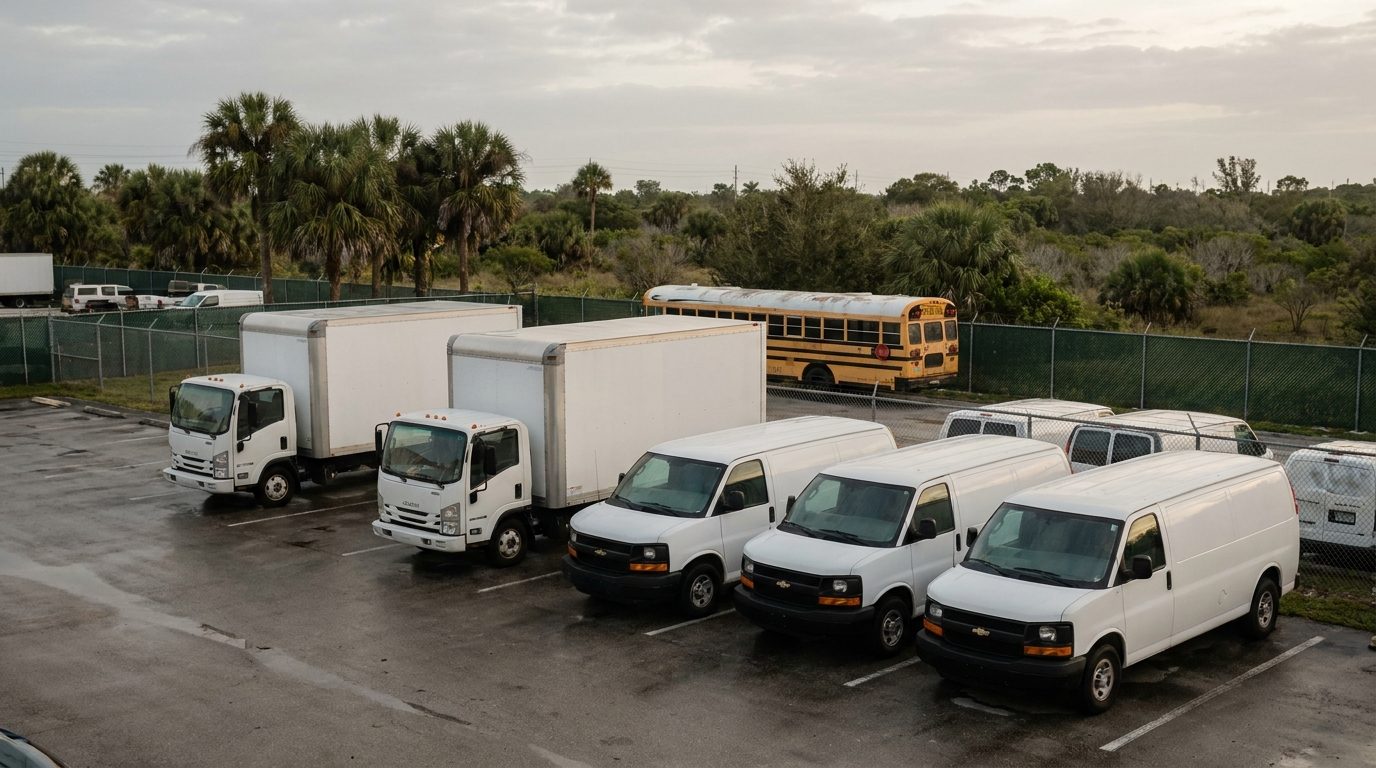
A fleet is the only account in this business where the infestation drives itself between your locations. A roach that gets into a cab at one terminal is at the next terminal by Thursday. Venus runs commercial fleet programs across Florida - box trucks, cargo vans, school buses, sleeper cabs, ambulances, transit and municipal - treating the vehicles and the yard they park in as one account, on one agreement.
The vehicle is the symptom. The yard is the source.
Most pest companies quote a fleet by the vehicle. That is how an operator ends up paying for the same problem four times a year, forever. Vehicles do not generate roaches. Break rooms, driver's rooms, wash bays, dumpster pads, shop cardboard and floor drains generate roaches, and the vehicles carry them out to the rest of the fleet. We map the yard first, then the fleet, and we price it as one account.
Nine kinds of fleet. One program.
The vehicles differ. The failure mode does not: people eat in them, things get stored in them, and they all come home to the same yard.
Box Truck & Delivery
Cabs, cargo boxes, liftgate wells and the dock they back into. Cardboard is the vector - it arrives on the pallet, it lives in the box, and German roaches travel in the flute.
Cargo Van & Service
Plumbing, HVAC, electrical, landscaping and pool routes. Tool racks, parts bins, the glove box and the cooler nobody emptied on Friday.
School Bus & Student Transport
The heaviest food-debris environment in transport, full stop. Seat seams, the floor channel under the rail, the driver's area, and the bus lot itself.
Ambulance & EMS
Patient compartments, apparatus bays and crew quarters, on low-residue materials with documentation a medical director will actually accept. One of the two verticals we run across the whole state.
Sleeper Cab & Long-Haul
Bunks, curtains, storage cubbies and the bedding. Bed bugs and roaches arrive with the driver, stay with the truck, and get parked next to your other trucks.
Transit, Shuttle & Paratransit
Passenger cabins, seat frames, farebox surrounds, wheelchair track channels and the layover facility. High passenger turnover means high bed bug exposure.
Municipal & Public Works
Refuse packers, utility trucks, the motor pool and the fuel island. The only fleet type where fly pressure and rodent pressure both run hard at once.
Dealership, Courtesy & Rental
Loaner fleets, shuttles, rental rows and trade-ins that arrive carrying something. Handled alongside the showroom, service drive and lot on the dealership program.
09Food Trucks & Commissary
Mobile units plus the commissary they are required to operate from. Treated as a food-service account, not a vehicle account, because that is how it gets inspected.
 Seat seams and floor channels — student transport
 Bunk, curtain and storage — long-haul
 Apparatus bay and crew quarters — EMS
What actually gets inspected on a vehicle.
This is where nearly every fleet infestation starts, because this is where people eat. A cab gets inspected the way a kitchen gets inspected, not the way a car gets valeted.
- Seat rails, seat seams and the void under the seat base
- Under the dash, the fuse panel surround and the console
- Floor mats, floor channels and the step well
- Door cards, map pockets and the glove box
- Sleeper bunk, curtain track and storage cubbies where fitted
The large enclosed space behind the cab, whatever it is carrying. Different fleets, same harbourage.
- Wall voids, E-track and logistics track channels
- Seat frames, wheelchair track and stanchion bases on passenger units
- The floor-to-wall junction, which is where debris collects and never gets swept
- Insulation gaps, liner seams and damaged panel edges
- Cabinetry, drawers and supply bins in EMS and service bodies
Nobody quotes this and it is where the real money goes. A unit that sits over a weekend is a heated, sheltered nesting site.
- Nesting material on the intake plenum, battery tray and firewall shelf
- Wiring loom inspection for chew damage
- Cabin air filter housing, which is both a nest site and a smell complaint
- Cowl drains and the plenum where leaf litter collects
How they get in, and where they build when a unit is out of service or waiting on parts.
- Frame rails, cross members and spare tyre carriers
- Wheel well liners and splash shields
- Body mount gaps and unsealed grommet pass-throughs
- Units sitting more than two weeks, flagged for a closer look
And what gets done to the site itself.
The yard is serviced on every visit. Vehicles run on rotation. That ratio is the whole method, and it is why a Venus fleet program stops costing you more every year instead of less.
Microwave surround, vending, the fridge motor housing and the cabinet toe kicks. In a fleet yard this room is the source more often than every other location combined.
Lockers, paperwork stacks, upholstered seating and the corners where personal bags get left. Also where a bed bug introduction shows up first.
Cardboard arriving with every order, parts bins, waste oil area and the racking. Rodent pressure and roach harbourage in the same room.
Trench drains, floor sinks and the organic film inside them. This is where drain flies and small flies breed, and cleaning the floor does nothing about it.
Compactor seals, the pad itself, the grease around it and the fence line behind it. Treated as a perimeter problem, not a housekeeping note.
Light poles, landscape islands, fence line, retention edge and any structure the yard backs onto. Numbered exterior rodent stations plotted to your site plan.

Modern wiring harness insulation is largely soy-based, and rodents will chew it. A unit down for a loom repair is two days of lost revenue plus a bill that dwarfs a year of pest service. Our fleet programs run exterior rodent pressure at the yard as hard as they run interiors, because that is where the repair invoices actually come from.
Bed bugs travel in the seat, not the building.
Sleeper cabs, paratransit units, ambulances and transit seating all take on bed bugs from the people who ride in them, and every one of those units then parks next to the rest of your fleet. A unit found in week one is a contained problem and a two-hour job. The same unit found in month three is a yard-wide problem and a very different invoice. We inspect for it on a schedule instead of waiting to be told.
Scheduled Inspection
High-exposure units are inspected on a set rotation - seams, bunk, curtain track and seat frames - rather than only when a driver complains.
Contained Response
A positive unit comes out of service and gets treated as a unit, not as a fleet. Adjacent units get inspected the same day.
Written Record
What was found, on which unit number, on what date, and what was done. Fleet managers need that record for HR as much as for us.
The hardest fleet in this business, and one of the two we run statewide.
An ambulance is a patient care environment on wheels. Units are never all in one place, the materials have to be low-residue and low-odour, and the documentation has to satisfy a medical director rather than a facilities manager. Venus runs EMS operators across Florida on one agreement, on a rotation built around your shift change instead of our route.
- Patient compartments and cab interiors on a rolling schedule that works around unit availability
- Apparatus bays, supply rooms and the floor drains that keep bringing the problem back
- Crew quarters, day rooms, bunk rooms and station kitchens - almost always the actual source
- Low-residue, low-odour materials placed in voids and harbourage, never sprayed across surfaces a patient contacts
- Written service reports filed for your medical director, with labels and Safety Data Sheets kept on site and published online
The station kitchen is almost always the source and the units are the symptom. Crews eat at the station, food goes into the truck, and the population travels with the vehicle. Treating the ambulance without fixing the day room is how an operator ends up doing this every three months forever. Healthcare facilities get the same documentation standard - see healthcare facility pest control.
Built around your dispatch board.
Yard Every Visit
The site is serviced on every single visit, because the site is what re-seeds the fleet. This is not the part we rotate.
Units On Rotation
Vehicles are worked across a visit window as they come available. We do not ask you to park the fleet.
Your Hours
Night, weekend and shift-change windows for transit, EMS and 24-hour operations. Scheduled around you.
One Invoice
Every yard, every unit, one agreement and one point of contact - however many counties it crosses.
On site in 24 hours.
Commercial accounts on a signed service plan get an on-site response within 24 hours, every day of the year outside national holidays. Covered pest between visits? We come back and re-treat, free.
That is written into the agreement, not just onto a website.Straight answers.
Do you quote a fleet by the vehicle or by the site?
By the account. A per-vehicle quote is how an operator ends up paying for the same problem four times a year, because the vehicles are not what generates the population. We price the yard and the fleet together, service the yard on every visit and work the units on rotation.
How do you service units that are out on route?
We work a rolling schedule with your dispatcher or shop foreman. Units get done as they come available across the visit window rather than us asking you to park the whole fleet at once. For 24-hour operations we take a night or shift-change window.
What materials do you use inside a cab or a patient compartment?
Low-residue, low-odour products placed into voids and harbourage rather than sprayed across surfaces people touch. Every label and Safety Data Sheet we carry is published on our product list, so your safety officer or medical director can read it without calling us first.
Can you cover yards in more than one county?
Yes, and it is most of what we do. Fleet and dealership work is the reason we run statewide - six Florida markets are live from the Keys to Orlando, quoted as one program with one invoice.
Do you handle bed bugs in sleeper cabs, buses and paratransit?
Yes, and we inspect for them on a schedule rather than waiting for a driver complaint. A positive unit is pulled, treated as a unit, and the units parked either side of it get inspected the same day. You get a written record by unit number.
Can you do anything about rodents chewing wiring?
That is an exterior rodent problem at the yard, not a vehicle problem, and it is treated as one. Numbered stations plotted to your site plan, the perimeter and fence line worked, and engine bays checked for nesting material on units that sit. It is the single highest-value part of a fleet program.
Do you service food trucks and mobile kitchens?
Yes, as a food-service account rather than a vehicle account, because that is how it gets inspected. The unit and the commissary it operates from are covered together, with the documentation a health inspector expects to see.
What documentation do we get?
A service report filed after every visit, a numbered and plotted device map for the yard, current labels and Safety Data Sheets kept on site and published online, and a written corrective action record after any finding. Per-unit records where your operation requires them, which is usual for EMS and school districts.
We come out, walk the site, document what we find and email you our findings, pricing and options. If we are not right for you we will say so.